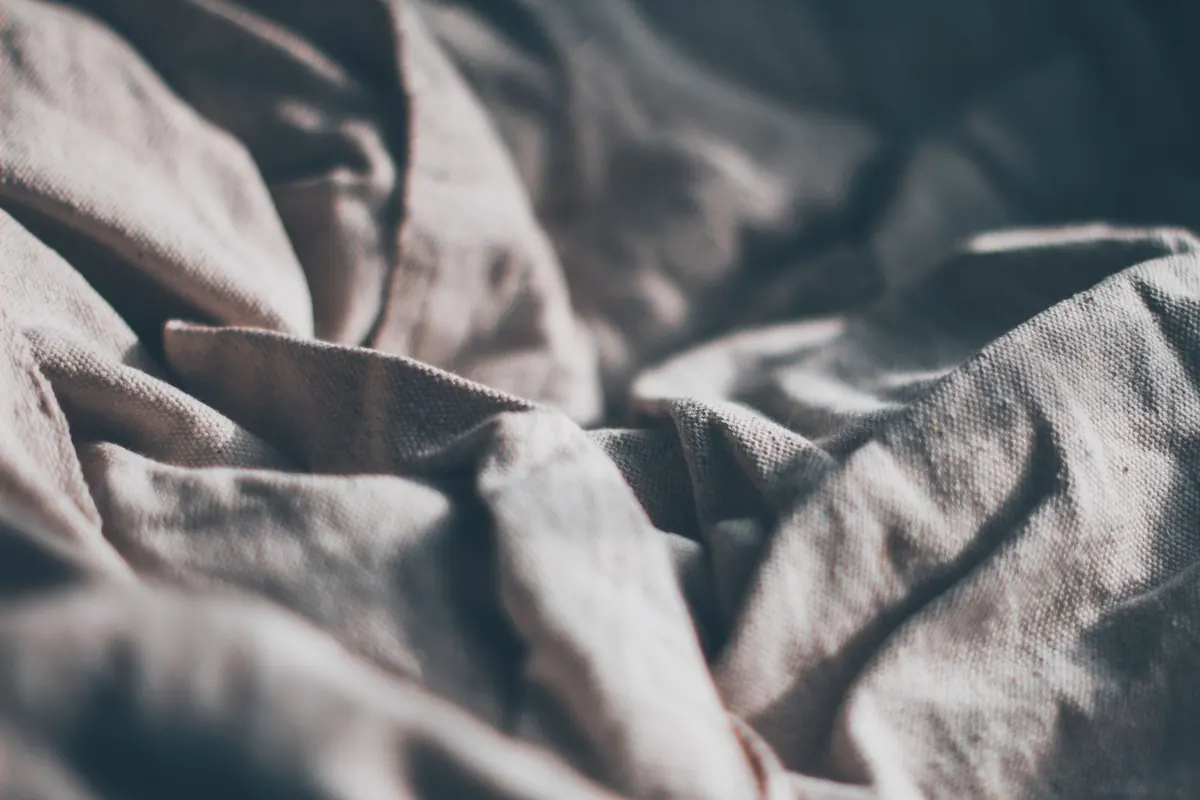
A new length of unwashed linen has a particular feel: dry, faintly papery, stiff enough that a corner stands up on its own when you hold it. Plenty of people love that crispness. Most, though, want the linen they picture when they hear the word — soft, slightly rumpled, easy against the skin. Stonewashing is one of the ways that softness gets made. It changes the cloth in ways you can see and feel, and it comes with a few trade-offs worth knowing about before you spend money.
Traditionally, the fabric goes into a large washing drum with pumice stones, water and sometimes a mild detergent, and tumbles for hours. The stones knock against the cloth and abrade the surface of the flax fibres. Many mills now use rubber balls, abrasive rollers or cellulase enzymes instead — cleaner, more even, and kinder to the machinery. Either way, the principle holds: a fine layer is taken off the outside of the fibre.
Linen takes well to it. Flax fibres are long, strong and naturally irregular, which is where that slubby texture comes from. Abrasion smooths the high spots first, so the cloth ends up softer to the touch while keeping its uneven character. A stonewashed linen still looks like linen. It just feels less like sacking.
These labels get used loosely. Garment washed usually means the finished item — a shirt or a pair of trousers — was washed rather than the fabric before cutting. Enzyme washed tells you the softening was done chemically. Stonewashed is often shorthand for any pre-softened linen, whether or not a stone came near it. If the exact method matters to you, ask; a good retailer will know.
The most obvious difference is in the hand. Unwashed linen feels cool and slightly waxy. Stonewashed linen feels softer, with a faint nap, a bit like a shirt you have owned for years. Colours read chalkier: deep indigo and charcoal look slightly faded from the first day, and white leans towards ivory rather than bright. The surface is matte, where pressed linen has a low sheen.
Creasing changes too. Stonewashed linen still wrinkles — it is linen, after all — but the creases are rounder and softer, more of a rumple than a knife-edge. For anyone who dislikes ironing, that is the main draw.
Stiffness in linen comes largely from friction between fibres. Abrade the surface and the fibres slide past one another more easily, so the cloth hangs closer to the body and falls in softer folds. A shirt feels broken in from the start. A duvet cover moves rather than stands up. Curtains in a heavy stonewashed linen drape beautifully, but they hold a crisp pleat less well than an unwashed one.
Weight still matters more than finish. As a rough guide: shirtings sit around 120–150 gsm, bedding around 165–190 gsm, and throws or towels upwards of 200 gsm. Ask for the figure in grams per square metre. Thread count, so often quoted for cotton, tells you very little about linen.
A little, yes. The process removes fibre, so a heavily stonewashed lightweight cloth starts life thinner than the same fabric unwashed, and the broken surface fibres are slightly weaker. In practice, wear shows first at friction points: pillow edges, sheet corners, underarms, cuffs, the seat of trousers. Good-quality stonewashed linen bedding will still give you many years of use.
It is worth knowing that crisp linen softens on its own. Ten or twenty washes will take an unwashed sheet a long way towards stonewashed softness while keeping more of its fibre intact. So if maximum longevity is your priority, choose linen that has been washed once or lightly tumbled rather than heavily distressed. If you want softness from night one, the trade-off is a reasonable one.
One more thing to watch: a broken surface can pill or shed, particularly in blends where linen is mixed with a shorter, cheaper fibre. Expect a little lint in the first few washes. Ongoing pilling is a quality signal.
Wash cool, at 30°C, with a gentle detergent and a half-full drum. Skip bleach, and skip fabric softener, which coats the fibres and reduces the absorbency that makes linen towels and sheets so pleasant to use.
For drying, you have a choice. Line drying in a breeze gives a crisper finish; a short tumble on low gives a softer, fluffier one. Either is fine. Iron on a low setting with steam if you want a smoother look, but the whole point of stonewashed linen is that you can skip it. Fold while still slightly damp and most of the sharp creases will fall out on their own.
Stonewashed linen is not better or worse than the crisp kind; it is a different point on the same line. If you want softness immediately, low-maintenance creasing and a relaxed look, choose a mid-weight washed linen. If you want the cloth to last as
Photo: Steve A Johnson / Pexels
A practical guide to visible mending, patching and cutting down worn linen sheets — plus simple projects that turn...
A practical guide to common linen weaves — plain, twill, herringbone, basket, sateen and huckaback — explaining how...
How to pair linen curtains with cottages, Georgian rooms and Victorian terraces — choosing colours, linings and...

Celebrating the beauty and versatility of linen..
