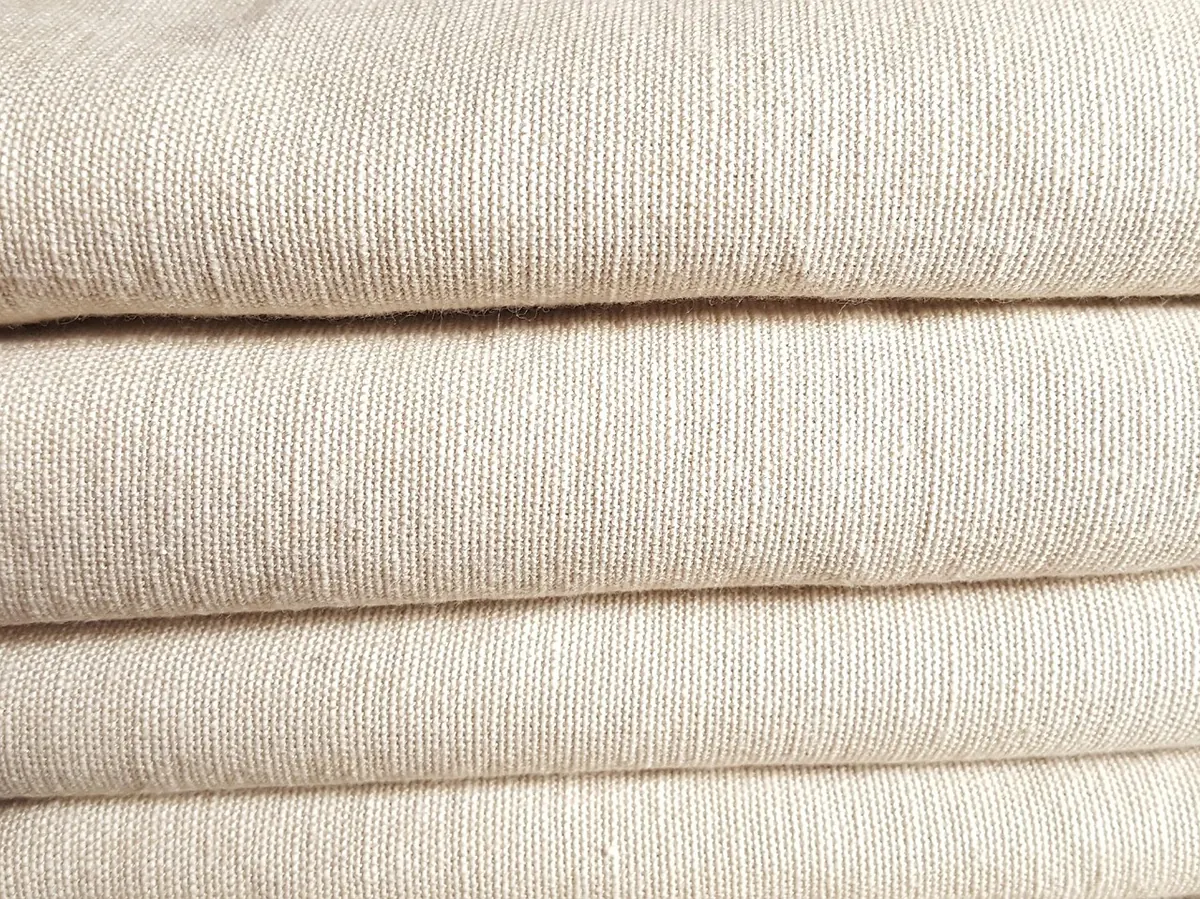
Two linen shirts can hang side by side, cut to the same shape from cloth of the same weight, and behave quite differently on the body. One stays crisp and holds a sharp fold down the sleeve; the other falls soft, moves with you and barely shows a crease. The difference is not the fibre but the weave — the way the lengthways and crossways threads cross each other on the loom. Learn four or five structures and you can predict how a piece of linen will drape, crease, wear and wash before you commit to a metre of it.
Every woven linen is built from two sets of threads. The warp runs lengthways, held under tension on the loom; the weft travels back and forth across it. A weave is the order in which those two sets pass each other — over one, under one, over two, under three — repeated across the width and down the length of the cloth.
Linen yarn is stiff and has almost no stretch, which is why structure shows up more clearly in linen than in cotton. A twill's diagonal reads like a pencil line. A loose basket weave looks like a grid of small windows. Once you know what you are looking at, the cloth on the shelf tells you what it is going to do.
Plain weave is the simplest structure there is. Each weft thread passes over one warp thread and under the next, then reverses on the following row, giving a fine, even grid. It is the most common linen weave and the one most people picture when they think of the fabric.
Expect a firm, stable cloth that resists distortion and takes a sharp press. It creases honestly — a fold in plain-weave linen is a proper fold, not a suggestion — and it has that familiar crisp snap when you shake it out. Woven tightly from fine yarns it can feel almost smooth; woven loosely from thicker yarns, as rustic tablecloths are, you get the slubs and texture that make linen look like linen. Bedding, shirts, napkins, tablecloths, curtains and aprons all suit it. Because the strain is spread evenly through the cloth rather than concentrated in long threads, it also wears evenly.
Twill sends the weft over two or more warp threads before it passes under, and each row steps sideways by one thread. That produces the diagonal lines you see on denim and on classic linen trousers.
Fewer interlacing points means a softer, more pliable, more fluid cloth than a plain weave of the same weight. Twill is usually a little heavier and noticeably more resistant to abrasion, which is why it turns up in trousers, jackets, aprons and upholstery. The diagonal helps with creasing, too: it breaks creases up, so a twill trouser looks rumpled rather than shattered. Look for a clean, consistent diagonal, since a wobbly line usually means a slack weave. Two things to watch: the raised threads can snag on jewellery or a hook-and-loop fastening, and a hard, hot press can leave a shine on seats and elbows.
Herringbone is a twill whose direction reverses at regular intervals, making rows of V shapes that interlock like the spine of a fish. The structure underneath is still twill, so it feels soft and drapes well, but the alternating direction adds a subtle shadow and an almost woven-in stripe.
In linen it belongs to tailoring — jackets, waistcoats, wide-leg trousers, unstructured coats — and to heavier throws and cushions, where the pattern does the decorative work on its own. Scale matters more than you might expect. Fine yarns give a small chevron that reads as texture from a metre away and as pattern close up; chunky yarns make a bold zigzag that will dominate a room. If you are matching it to other fabrics, treat a large herringbone as a pattern rather than a neutral.
Group the threads — two or more warps and wefts travelling together as one unit — and you get a checkerboard of small blocks. Basket weave is airy, springy and a little rustic: excellent for curtains, cushions, casual summer shirts and lightweight throws. It is also looser, so it snags more readily and can distort if you cut it carelessly. Stay-stitch the edges before you sew.
A sateen weave floats the weft over several warp threads at a time, so one face is smooth and slightly lustrous while the reverse is dull. In linen it appears mostly in bedding, where the point is a cooler, smoother feel against the skin. The long floats can snag and show marks, so it is less suited to hard-wearing items.
Huckaback arranges small floats in a textured grid: absorbent, quick-drying and pleasantly rough, which is why it is the structure behind most linen towels and tea towels. Dobby and jacquard are loom capabilities rather than weave structures. A dobby loom makes small repeating motifs, stripes and checks; a jacquard loom controls individual warp threads to weave larger patterns such as damask. A "jacquard linen" label usually means the pattern is woven in rather than printed, which is generally a good sign.
In a shop, with no label to help you, these checks will get you most of the way:
If you are building a linen wardrobe or a linen home from scratch, start with plain weave. It is the most versatile structure, it takes a great deal of washing without complaining, and it looks right in almost every setting: bed linen, napkins, tablecloths, simple shirts and curtains. Add twill or herringbone when you want something to wear rather than something to lay a table with, since trousers, jackets and heavier shirts all benefit from the extra drape. Choose huckaback for towels, basket weave for curtains and cushions, and sateen only if you particularly want that smooth, cool hand in bedding.
Whatever you buy, remember that linen softens with washing. Wash at a moderate temperature with a gentle detergent, avoid overloading the machine, and line dry or tumble briefly on low. Press on the reverse while the cloth is still slightly damp: plain weave takes a crisp press happily, while twill and herringbone usually look better lightly smoothed than flattened.
And if you are ordering online and unsure, buy the smallest useful thing first — a napkin, a tea towel, a single pillowcase — then live with it for a week. Weave is one of those things you understand with your hands far faster than you understand it from a description.
Photo: spectagal / Pixabay
A practical guide to visible mending, patching and cutting down worn linen sheets — plus simple projects that turn...
How to pair linen curtains with cottages, Georgian rooms and Victorian terraces — choosing colours, linings and...
A practical, stain-by-stain guide to treating tea, wine, grease and ink marks on linen tablecloths — without...

Celebrating the beauty and versatility of linen..
