Linen has a reputation for being awkward. It creases the moment you sit down, and there is always the worry that one wrong wash will turn a favourite shirt into something better suited to a smaller person. In truth, linen is one of the toughest natural fibres you can own: it is stronger wet than dry, and it takes a hot iron better than cotton. Almost all shrinkage comes down to three predictable things — hot water, rough agitation and a long spell in the tumble dryer. Get those under control and your linen will hold its shape for years.
During weaving, flax fibres are held under tension and stretched slightly. Once the finished cloth gets wet and warm, those fibres relax and draw back towards their natural length. That is why most shrinkage happens in the first wash or two and then settles down. Heat speeds the process up, and mechanical agitation — a fast spin, an overloaded drum, a tumble dryer — compacts the weave further.
A little movement on a hem or a pillowcase is normal and disappears under a press. A jump of a full size is not normal. It usually means the water was too hot, the cycle too rough, or the drying too fierce.
Start with the care label rather than a general rule. A washtub symbol with a number tells you the maximum temperature; a bar underneath means a gentler cycle. A crossed-out tumble dryer symbol is there for a reason. If the label says dry clean only, believe it — heavily pleated, coated or beaded linen is not a job for a domestic machine.
For everyday washing, 30°C is the safe default and the setting most linen garments are labelled for. Colder is fine if the piece only needs freshening — a shirt worn over a vest, trousers worn once. 40°C is acceptable for sturdy white or undyed linen if the label allows it, but there is rarely a reason to go higher, and never above what the label states.
Choose a gentle programme: the one your machine calls delicates, hand wash or wool, or a dedicated linen cycle if it has one. The setting that matters most is the spin. Keep it at 600 to 800 rpm, lower if your machine allows. A fast final spin is the simplest way to set hard creases into linen and strain the seams, and it saves you very little drying time.
Liquid detergent is easier on linen than powder, particularly in a cool wash where granules can fail to dissolve and leave a chalky residue in the weave. A mild, non-biological formula is the safest choice, and for coloured linen look for one without optical brighteners, which dull deep dyes over time. Use roughly two-thirds of the dose recommended for a full load, adjusting for soft water. Chlorine bleach is out — it weakens the fibre and yellows white linen.
Skip fabric softener as well. It coats the fibres, reduces absorbency and takes away the crisp, slightly dry handle that makes linen worth owning. If you miss the softness, a splash of distilled white vinegar in the rinse compartment is the traditional alternative.
Never wring or twist linen to remove water. Roll the piece in a clean towel, press gently, and let the towel do the work.
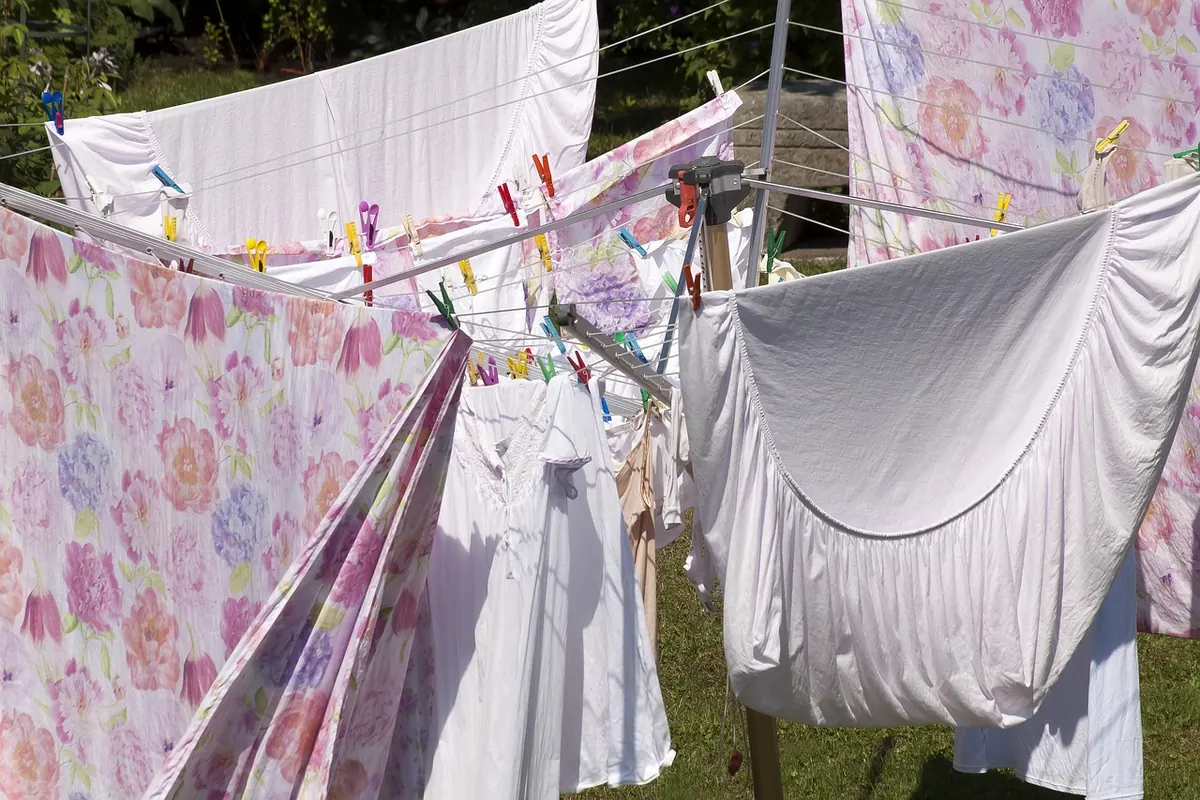
Air drying is the only reliable way to avoid shrinkage, and it takes less time than you would think. Dry in the shade, because direct sun fades colour faster than it dries. Shirts and dresses are better dried flat on a rack or over a padded rail than hung soaking wet from the shoulders, which stretches them out of shape. Peg heavier items by the hem.
If you must use a tumble dryer — a towel or a sheet on a wet week — use the lowest heat setting, take the load out after five or ten minutes while it is still damp, and reshape it straight away.
Reshaping is the step most people skip, and it is the one that saves a garment. While the linen is damp and warm, lay it flat and ease it back to its original measurements: pull the hem gently into line, smooth the side seams, pat the collar and cuffs into shape, and dry knitwear flat. Damp linen stays malleable for longer than you would expect, so you have more leeway than you think.
Ironing is easiest when the fabric is still slightly damp. Use a hot setting with plenty of steam, press on the wrong side, and use a pressing cloth on dark colours to avoid a shine. Start with the collar, cuffs and placket, then work along the body. Linen will never look like a stiff cotton shirt, and it is not meant to.
Wash linen less often than you think you need to. It is naturally breathable and in practice needs laundering less frequently than cotton or synthetics, so a shirt worn over a vest or a dress worn for an evening can usually be aired overnight and worn again. Spot clean small marks with a damp cloth rather than washing the whole piece.
Store linen folded in a cool, dry, dark place. Wire hangers leave shoulder marks, and sunlight on an open rail will fade a favourite colour within a season. Beyond that, the method is short: cool water, mild detergent, slow spin, shade drying, and a press while still damp. It works on everything from a pillowcase to a summer suit.
Photo: stux / Pixabay
A practical guide to visible mending, patching and cutting down worn linen sheets — plus simple projects that turn...
A practical guide to common linen weaves — plain, twill, herringbone, basket, sateen and huckaback — explaining how...
How to pair linen curtains with cottages, Georgian rooms and Victorian terraces — choosing colours, linings and...

Celebrating the beauty and versatility of linen..
